Ash Wednesday as Church Reset

Ash Wednesday, which initiates the season of Lent, is marked by the imposition of ashes to the foreheads to worshippers; it is a sign of mortality, humility, and remembrance. The day ought to be an important Christian holy day both for us personally and for the ecumenical Church more widely to undergo a spiritual “re-set.”
Christianity has rituals, rhythms, liturgies, as well as feasts and fasts which reinforce the gospel message and the gospel life. Ash Wednesday should be one of the most important of these liturgical rites. Why?
The earliest Protestant churches were called “evangelical” because they were recovering something of the Good News (euangelion) from a corrupt sixteenth-century ritualistic church in Europe that often lost the message of the gospel. Such rituals often were not even understood by the gathered worshippers since they were in Latin. Evangelical reformers recovered the message and, in doing so, reformed the liturgy without losing the important rhythms and patterns of the Christian life. Some of the rituals took on a new and more profound importance for the reformers, such as confession and fasting, with a greater appreciation for and greater focus on the cross of Christ.
The rhythms of the Church calendar keep us grounded in the Christian story of redemption and help to prevent cheap theology from creeping in. The liturgy and the liturgical calendar teach us, remind us, and protect us. They can be understood as guard rails to orthodoxy, or (using another analogy) as cultivating deep roots for Christian identity. As we enter this season of Lent, I would like to encourage our evangelical friends to embrace this important season in the life of the church. It is a time of reflection, repentance, and reminder.
We reflect on the suffering, death, and resurrection of Jesus Christ on our behalf. It is important to reflect on the cross and (as a side note) there is no reason for Protestants to avoid pondering a crucifix, since this is an image of the real suffering that Jesus embraced on our behalf. Our salvation was and is costly.[1]
Then we need to repent of our sins—temptations not resisted and unhealthy habits that reflect our bent and broken desires. Repentance is both good for the souls and necessary for our obedience and for the work of Christ in our lives. Surrender takes time and it must be done over and over again. Repentance is a personal, private, and holy encounter with God, and at the same time it is a communal—even uniting—moment that strengthens our church community life.
Finally, we need to remember or be reminded that beyond the suffering of Christ and our own repentance there is hope. Suffering and repentance are temporary; the glory and joy are eternal. Remember the little cost for the great, good, and glorious reward.
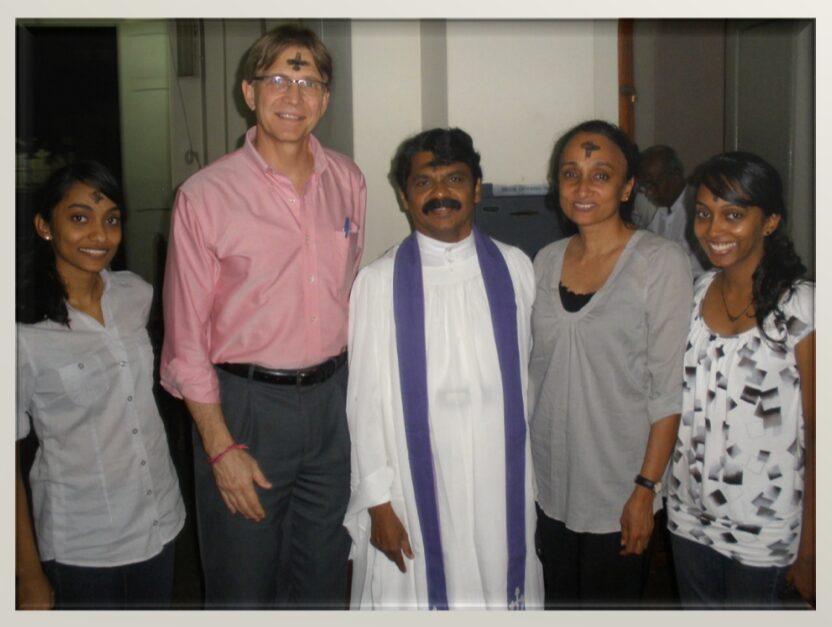
Ash Wednesday with Father Sunil and family in Sri Lanka (2012)
Thus, on Ash Wednesday, as the pastor or priest marks my forehead with wet ashes in the sign of the cross, and I hear the softly spoken the words” Memento, homo, quia pulvis es, et in pulverem reverteris (“Remember you are dust and to dust you shall return,” Genesis 3:19), such a moment will be a healthy reminder to consider my salvation. From the early days after the crucifixion and resurrection of Jesus, his followers “prepared” each year to remember that time as the fulcrum of all of time, the “center of all history.” As we are preparing to remember and to live into the great reality that death is real, we also stand upon the hope that it has been conquered. But before remembering the resurrection, it is important to remember the death.
Many of the ancients emphasized the importance of remembering your death (memento mori). St. Hesychios the Priest says, “Whenever possible, we should always remember death, for this displaces all cares and vanities, allowing us to guard our intellect, and giving us unceasing prayer, detachment from our body and hatred of sin. Indeed, it is a source of almost every virtue.” [2] Thomas á Kempis, in The Imitation of Christ (circa 1425), has a whole chapter on “Thinking about Death” (chapters 23). Anglican priest Jeremy Taylor’s classic volume Rules and Exercises of Holy Dying (1651) was very influential in the life and theology of John Wesley.
Of all people in the world, we Christians ought not be afraid to think of, ritualize, or even talk about death. As we ponder our mortality, we also proclaim, “Where O death is your sting? O grave, where is your victory?” (I Corinthians 15:55). It is healthy in every way to look at death with the resurrected eyes of Christ.
On Ash Wednesday we have the privilege of reconnecting with the historic and global (and ecumenical) church in this sacred rhythm or pattern of the Christian life. As Evangelicals, we can and should embrace the liturgical year and its practices as a meaningful way to deepen our unity one with another and also our life together in Christ.
We will die. . . but Christ is our life!