Ex Fonte Excerpt: Cast Them Out – A conversation with an exorcist Fr. Vincent Lampert
Do you accept the theory some have suggested that demons fell because they couldn’t accept the Incarnation?
A lot of times when people think about the fall of the Devil and his demons, they think of the sin of pride. That certainly is a part of it. But the rejection of the Incarnation is also central. God chose to unite his nature with human nature. The Devil could not accept that a creature he considered inferior to himself—namely, the human person—would be where God would choose to unite himself.
The Incarnation means human flesh being elevated higher than the angelic nature. The Devil, in pride and arrogance, could not accept this. When he chose to rebel, as we know from the book of Revelation, he convinced one-third of the angelic choir to join him in his rebellion against God. The Devil was cast out of heaven, but the Devil wasn’t cast out of creation. God can still use the Devil to bring about some greater good. So the Devil still has a role to play in history, if you will.
When the demons rejected God, they rejected the role he had assigned to them and instead go about executing the Evil One’s plans. What does this look like?
The activity of the Devil can either be extraordinary or ordinary. The Devil tries to trip us up. The Devil wants us to make the same choice he and one-third of the angels made—to reject God. The Devil wants us to join him in damnation and alienation from God. There are four types of extraordinary demonic activity: infestation—the presence of evil in a location or associated with an object; vexation—physical attacks, cuts and bites and marks and bruises that appear on the body; demonic obsession—mental attacks; and demonic possession—whereby the Devil or some other fallen angel will treat the human body as if it were its own, using the person’s mouth to speak, their eyes to see, their ears to hear.
Then there is ordinary demonic activity where the Devil tries to trip us up in our daily lives. He tries to get us to buy into his deception, his lies. If we do, it leads to division. We find ourselves broken. That division will lead to diversion, whereby we look for some substitute for God—something that may fill the emptiness in our lives: alcohol, drugs, pornography, whatever it might be. But that only will leave us feeling even worse. That diversion leads to discouragement, where we just fall into a sense of apathy, whereby we say, “I just don’t care.” When we arrive at discouragement, it’s a crossroads. We have a choice to make. One direction leads to death—always spiritual, the complete rejection of God. But the other pathway leads to discipleship. We recognize that we need God.
The good news is God does not leave us alone to fight the demonic. God gives us his very self through the life of the church, the sacramental life of the church, and even the community itself. God does not want anyone to suffer alone.
Out of all the different forms of extraordinary diabolical activity, physical possession is the worst but it is also the rarest, correct?
Possession does occur. It’s real. It does happen. But it’s not as real or prevalent as people may think. It accounts for maybe one out of every 5,000 cases that I deal with. Other people can be dealing with infestation or vexation, physical attacks, the obsession, the mental attacks where the Devil’s literally trying to get inside of their heads.
You said there are different gateways that are entry points for the demonic. Can you elaborate on that?
Usually when it comes to entry points, [the exorcist] is trying to look at the road map that somebody created that led them to having this extraordinary demonic affliction. Once I understand the route that the person took, it allows me to understand the agreements that these people entered into with demons. Demons are very legalistic. They understand the rights that they have and they will always try to demand them.
Some of the entry points would include ties to the occult. The word occult comes from the Latin word occultus meaning “hidden” or “secret.” It focuses on knowledge of the paranormal. So, when people tap into things like going to see a psychic or a medium, practicing magic or witchcraft, the use of crystals and all of that, they’re tapping into the power of the Evil One. And that’s why it’s dangerous.
Other ways include a life of habitual sin, so that a person is no longer able to call sin a sin, inviting a demon in. Oftentimes people believe that they can control the Devil. They’re deceiving themselves because we can never use the Devil for our benefit. The Devil will always use us, with the result that the Devil really wants to destroy our lives.
Unfortunately, the Devil may deceive people by giving them a brief moment of fame or fortune. But whenever the Devil does something, he’s going to want to be paid in full. When the Devil comes to demand his due is when people begin to see their lives fall apart. That’s when people turn to the church or to exorcists. They also need to recognize the importance of God in their life. Casting demons out is the easy part. Convincing people to invite God in seems to be the more difficult part.
*
Fr. Vincent Lampert is an American Catholic priest best known as a leading exorcist in the United States. He trained in Rome at the Pontifical North American College and he has assisted in over 40 exorcisms under mentors such as Fr. Carmine de Filippis. He has performed or consulted on hundreds of cases, traveling internationally. He serves as the pastor of St. Michael Parish in Brookville, Indiana, and St. Peter Parish in Brookville, Indiana, while continuing his role as the archdiocesan exorcist. He is the author of Exorcism: The Battle Against Satan and His Demons (Emmaus Road Publishing, 2020).
This interview is excerpted from a conversation with Fr. Vincent Lampert on Radio Maria Ireland, which occurred on October 27, 2025. Used with permission.
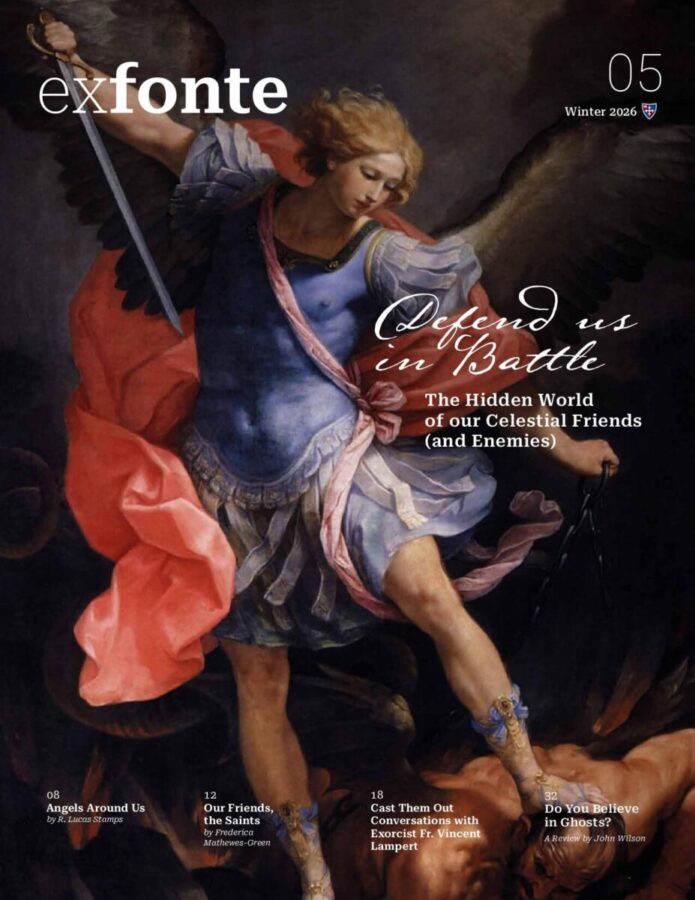 A longer version of this article appears in the current issue of Ex Fonte magazine. Purchase the individual issue or subscribe.