Ex Fonte Excerpt: The Desire of Our Hearts
 A conversation with Adonis Vidu about our love affair with the Trinity
In his next book, provisionally titled The Christian Life: A Trinitarian and Nuptial Framework (IVP Academic), Dr. Adonis Vidu examines the striking biblical image of Christ as the bridegroom and the Church as his bride.
Would you summarize the essence of your book and what drew you to the theme of the Trinity and marriage as a metaphor for how Christians relate to God?
This is one of multiple volumes in the series Pillars of Christian Dogmatics, from the doctrine of the Trinity to the doctrine of providence, virtues, angels and so on. When the editors (Matthew Barrett and Craig Carter) first approached me to contribute a volume to the series, I told them I’d be interested in writing something about the experience of the Trinity. I had written some material on the Trinity a few years ago, but I wanted to explore the topic more deeply. We decided that the best fit for this exploration would be this theological topic called “the Christian life,” which appears in some dogmatics but not others. I thought that might be a good placeholder for some of the reflection I wanted to do on experiencing the Trinity. So “the Christian life” is the experiential side of how we relate to God.
The volume is covering more or less traditional aspects of the Christian life. Most theologians’ treatment of the Christian life goes to ethics, turning it into a kind of a treatise on ethics or virtues. I’ve selected those aspects that are lending themselves more to a nuptial analysis. So after I lay some foundations in trinitarian theology, I go on to various specific chapters of Christian life—for example, the spiritual interpretation of Scripture, which can be seen as a nuptial form of reading, or a reading informed by love. Then I go through chapters on prayer, baptism, the Eucharist or communion, marriage, virginity, gender, suffering, and death. Hence the title The Christian Life as opposed to The Christian Program or The Christian Ethics.
Would you say that the metaphor of marriage is the peg on which you hang further exploration of the Christian life and the Trinity?
You can say that. Christian life is the experiential side of how we live as Christians. You might say Christian life is the dogmatic locus where one can discuss the experience of the Trinity. It’s the placeholder, the peg for that. And I’m not diving into the doctrine of the Trinity as such, but my exploration is geared towards making sense of the Christian life as a marriage to Christ. I’m leveraging this very important biblical metaphor to organize material about Christian life.
I came across this metaphor as I was reading mystical theology—bridal mysticism, obviously. But one thing that really compelled me to dig more deeply into this direction is the work of Jerome Zanchi [1516–90], an Italian reformer and professor of theology at the University of Heidelberg. He wrote a book on the spiritual marriage between Christ and every individual believer. I realized that this is not just a Catholic notion. It is quite significant in the Protestant tradition as well. I found it also in the Puritans, who are very fond of the bridal imagery. From there it became a matter of exploring how this helps us understand our participation in the Trinity.
In Ephesians 5 Paul uses the metaphor of marriage to describe the relationship between the church and the Lord. You say in your book that “our desire is manifesting itself in an enfleshed way by glimpsing God in his creatures, by enjoying the spiritual in the material and thus the material in the spiritual.” Does this “spiritual in the material” make the human institution of marriage sacramental?
There’s a whole chapter where I’m debating this and I’m saying a cautious “yes.” In the history of Protestantism, we have practically considered marriage to be sacramental while denying any special sacramental power that attaches to the words of the priest. But it is in some sense sacramental in that it shares in this divine goodness and holiness and it’s a great mystery and remains a mystery.
What does this metaphor of a mystical marriage to Christ mean for someone who’s never been married? Or for someone who’s in a bad destructive marriage? What’s the spiritual roadmap for that person?
For the pathological marriage, I think there is a path. The path is the usual discipline of the church, holding each other accountable and reminding ourselves that the husband belongs to the wife and the wife belongs to the husband. It’s a mutual indwelling. That’s the comprehensive union that I was speaking about. And I think this is where the Christian idea of marriage articulates the fact that it is never about just the two of them. Christ is also the head of that couple. And that obedience to Christ has to be at the foreground of our concerns as married people.
With regard to virgins or celibate people, I think first of all that it’s problematic to propose marriage as the absolute ideal for the human being. And I think it is appropriate to recognize that God has called, or may have called, people to vocations other than the married vocation. In fact, the way which Paul treats marriage sometimes is that he almost sees it as a kind of an impediment to your complete devotion to Christ.
Adonis Vidu is the Andrew Mutch Distinguished Professor of Theology. This conversation can also be viewed in full on Gordon-Conwell’s YouTube channel.
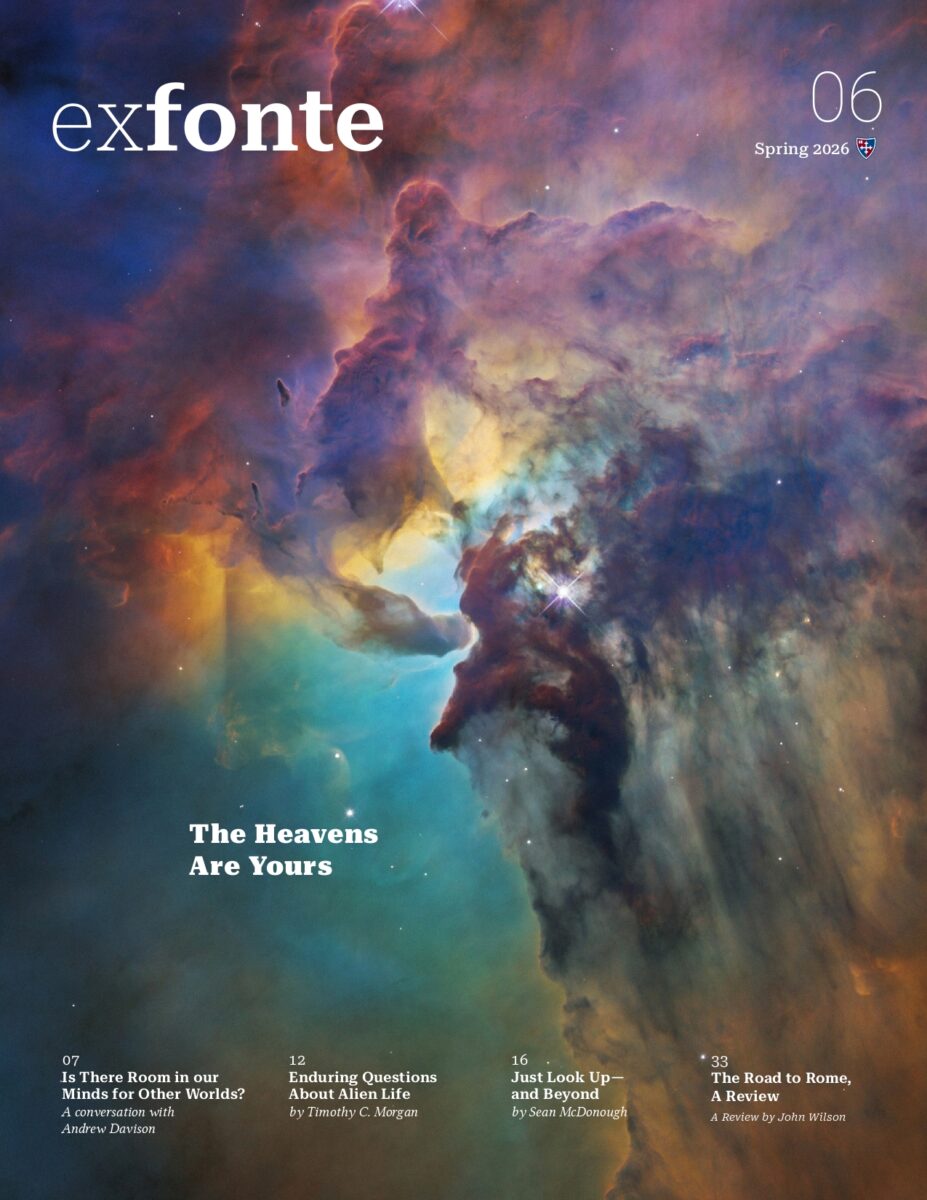 A longer version of this article appears in the current issue of Ex Fonte magazine. Purchase the individual issue.