Ex Fonte Excerpt: Enduring Questions About Alien Life

Timothy C. Morgan
“They’re real. But I haven’t seen them, and they’re not being kept in Area 51.” With that offhand remark on a widely watched podcast, former president Barack Obama managed to ignite a familiar American firestorm: curiosity, skepticism, and a surge of online speculation about extraterrestrial life.
Within days, Donald Trump responded by promising to declassify federal records related to unidentified aerial phenomena (UAP), unidentified flying objects (UFOs), and possible extraterrestrial encounters. The moment captured something deeper than a fleeting news cycle. It revealed how firmly the question of alien life—once confined to science fiction—has embedded itself in mainstream political and cultural discourse.
Obama later clarified his remarks, noting that while the sheer scale of the universe makes extraterrestrial life statistically plausible, he saw no evidence during his presidency that aliens have visited Earth. His clarification reflects the current scientific consensus: life beyond Earth is likely, but confirmed contact with intelligent beings remains unproven.
A Government Search for Answers
Public fascination has been intensified by recent government transparency efforts. In 2024, the Department of Defense released a comprehensive report compiled by the All-domain Anomaly Resolution Office (AARO), a unit established in 2022 to investigate anomalous aerial sightings across military domains.
The report, reviewing decades of sightings dating back to 1945, reached a clear conclusion: there is no verified evidence that any UAP represents extraterrestrial technology. Most incidents, it found, can be attributed to misidentified aircraft, atmospheric phenomena, sensor errors, or classified human-made systems.
Still, the report did not close the book on the mystery. A small number of cases remain unresolved—not because they point to aliens, but because available data is incomplete. That ambiguity continues to fuel speculation.
One of the most discussed incidents remains the 2004 “Tic Tac” encounter, in which U.S. Navy pilots observed a white, oblong object off the California coast exhibiting flight characteristics that appeared to defy conventional aerodynamics. While striking, such encounters highlight the limits of perception and sensor technology as much as they suggest unknown craft.
The AARO report also addressed one of the most controversial claims circulating in recent years: the alleged “Kona Blue” program. Investigators confirmed that such a program proposal existed but found that it never progressed beyond early planning stages. No materials were collected, no funding allocated, and no evidence of extraterrestrial artifacts was identified.
Whistleblowers, Testimony, and Doubt
Despite official findings, skepticism toward government conclusions remains strong. That skepticism was amplified during a high-profile 2023 congressional hearing, where three witnesses—David Grusch, Ryan Graves, and David Fravor—testified under oath about UAP encounters and alleged hidden programs.
Graves and Fravor described firsthand experiences with unidentified objects during military operations and have generally been regarded as credible observers. Their testimony reinforced concerns about aviation safety and the need for better data collection.
Grusch’s claims, however, went further. A former intelligence officer, he alleged that the U.S. government possesses recovered nonhuman craft and biological material from nonhuman entities (“biologics”). His assertions drew intense public attention—but also scrutiny. Because he did not present physical evidence publicly, critics argue that his testimony amounts to secondhand accounts rather than verifiable proof.
Scientists have been blunt about the standard required for such claims. Extraordinary claims demand extraordinary evidence—something that has not yet been produced.
. . . [T]he American fascination goes beyond science. It is cultural, psychological, and technological.
First, there is a long-standing distrust of government secrecy, reinforced by real historical examples—from Cold War intelligence programs to classified military research. When officials say, “there’s nothing there,” a significant portion of the public instinctively wonders what might still be hidden.
Second, media ecosystems amplify uncertainty. Streaming shows, viral social media clips, and online forums blur the line between entertainment and evidence. Algorithms reward mystery and speculation, often giving fringe theories the same visibility as verified reporting.
Third, the topic itself taps into existential questions. Are humans alone? Is there intelligence beyond Earth? These are not merely scientific inquiries—they are philosophical and, for many, spiritual ones.
Finally, generational differences matter. Surveys consistently show that younger Americans are more open to the possibility of extraterrestrial intelligence. Majorities express similar views globally.
Timothy C. Morgan, former deputy managing editor at Christianity Today, teaches journalism at Gordon College. He is a contributing writer to this magazine.
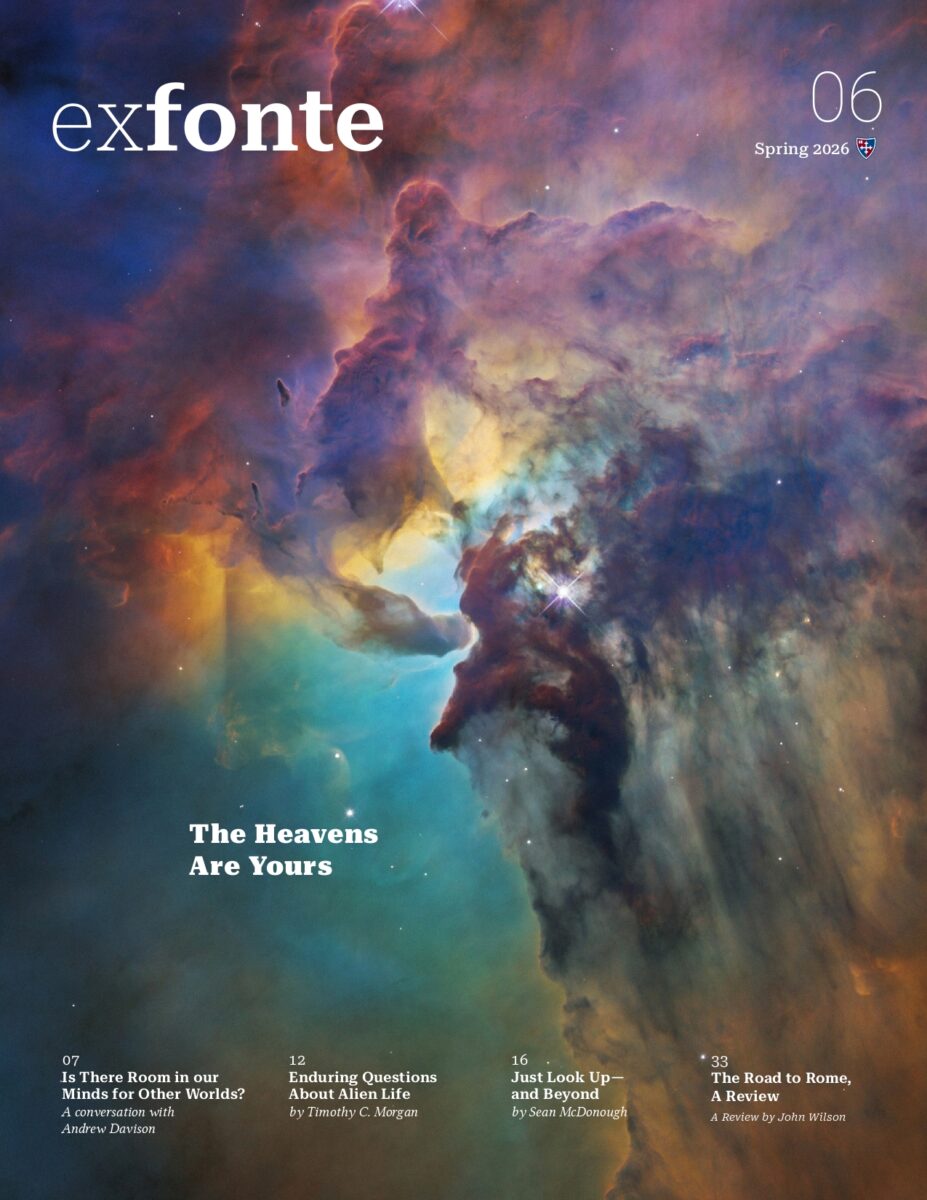 A longer version of this article appears in the current issue of Ex Fonte magazine. Purchase the individual issue.