Remembering Clare of Assisi: A Flower in Bloom
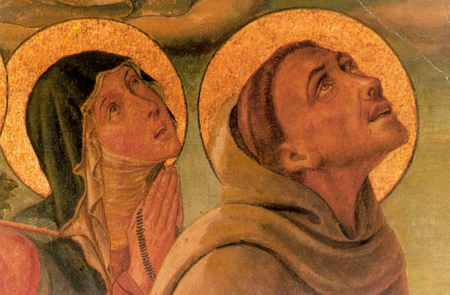
Wendy Murray (MATS ’85)
On this day, 773 years ago, as death closed in, Clare of Assisi was heard speaking the words, “You, Lord, are blessed for having made me.” These were strange words, and—as a writer of her biography—they mystified me. They seemed brash and audacious, suggesting that God blessed himself by creating Clare. Add to that the fact that Clare’s life was riddled with sorrow—in the sequence of her days she suffered one loss upon the next. Yet with her dying breath she proclaimed that God himself had been blessed by her existence, strained and sorrowful though it was. What could her dying words mean?
Clare was the eldest daughter of a family of high nobility in Assisi, Italy, and she was also the town beauty. As such, she was being prepared by her father for a marriage of rank and numerous suitors sought her hand. She could have had her pick of them, but she rebuffed them all. She abandoned her life of privilege to follow the town upstart, Francis Bernadone, who himself had renounced his rank and family. Together they vowed to live out their lives in penitence and poverty according to the mandate given by Jesus when he said, “If you want to be perfect, go, sell your possessions and give to the poor, and you will have treasure in heaven” (Matthew 19:21, NIV). Clare’s flight from her family home was a high-spirited gesture and she embraced it devotedly. By worldly standards, this was an unreasonable choice. She gave up power and station to land instead in the insecure territory of living as Jesus did.
Yet life’s unsparing realities upended her dreams. By the time Clare had reached the age of 34, Francis had died a lingering and painful death due to multiple illnesses, while she herself had contracted a malady that left her unable to walk. From that time till the day she died, she was confined to her bed and animated her duties as abbess from the confines of her small dormitory. Even so, she changed the landscape of her world and, in an upside-down way, rendered a kind of power sufficient to shut the mouths of popes.
How did she do this from such a diminished physical position? The first thing seemed to be that, even after experiencing much loss, Clare still saw poverty not as diminishment, but freedom. In a letter to a young woman of royal descent, Agnes of Prague, who herself had given up a life of privilege for Franciscan poverty, Clare wrote: “One clothed cannot fight another naked, because she who has something to be caught hold of is more quickly thrown to the ground.”[1] She called this the “glorious exchange”—swapping worldly station for the fleetness and liberation of the higher allegiance that gospel-poverty allows.
But the greatest clue in discerning the meaning behind Clare’s dying words came from another letter she wrote to Agnes: “Place your mind before the mirror of eternity! Place your soul in the brilliance of glory!”
The idea of seeing one’s life as if through a mirror, as a devotional exercise, captured the imaginations of many women in the Middle Ages, particularly women of rank who had given up royalty and nobility in exchange for penitence and poverty. Gazing into a mirror animated their holy imagination as these women pictured themselves in a sacred marriage in union with Christ. This spiritual vision, known as “bridal mysticism,” held transformative power for both Clare and Agnes (and countless other female penitents). Clare advised Agnes to see in her face the bejeweled spouse of the Divine Husband, “the King himself [who] will take you into the heavenly bridal chamber.”
The reflection Clare saw when gazing into the “mirror of eternity” was that of the one seen through the eyes of Christ, her Divine Husband and Beloved Spouse. Seeing herself that way, despite being sickly and bedridden, enabled her instead to see vitality; despite being poor, she saw glory, beauty, and nobility.
Such eyes enabled her to say at the moment of her death, “Go securely and in peace, my blessed soul . . . . and You, Lord, are blessed because You have created me.” Not many of us reach the place in our spiritual journeys where we understand that our true mission is to give back to God the unique glory he has imparted to each of us.
Clare’s life—with its twists, losses, and struggles—was like a planted seed that, with time and the workings of Spirit, became its destiny: a flower in bloom. At the end of her life’s journey, God crowned her days with the vision to see that he had perfected what he had made her to be, one through whom God himself could be blessed.
[1] “The First Letter of St. Clare to Agnes of Prague,” paragraphs 22–30, in Clare of Assisi: Early Documents (CA:ED), pages 45–46.
Wendy Murray is the associate director of accreditation and communications. Her biography, Clare of Assisi, Gentle Warrior, came out in in 2025 with Paraclete Press. In September, she is offering a short course on Francis and Clare of Assisi.