The Seal of the King
This blog post is part of the Jesus in the Old Testament Series.
The Old Testament doesn’t simply prepare the way for Jesus; it bears witness to him through promises, prayers, and patterns. In this series, Dr. Donna Petter, in her piece titled, “From the Calf to the Cross,” connects God’s justice and mercy in the narrative of Exodus in relationship to Christ’s sacrificial death. Dr. Trey Nation’s, “The Lament of the King,” highlights Jesus’ anguish on the cross and also the promise it portends as expressed through his cry from the first verse of Psalm 22. Finally, “The Seal of the King,” by Dr. Seong Park, explores how the prophecies of Balaam impart signs of the coming Messiah. This exploration invites readers to see the entirety of Scripture as one unfolding story, rich with allusions, that culminates in the coming and salvation of Jesus, the Coming One. (President emeritus Walter C. Kaiser, Jr. wrote the first such reflection.)
Seong Hyun Park
When Israel reached the plains of Moab after the exodus, Balak, king of Moab, summoned Balaam from the East to curse them. God overturned the plan, compelling Balaam instead to bless Israel and announce a ruler who would come in the latter days:
“A star shall come out of Jacob, and a scepter shall rise out of Israel; it shall crush Moab from one side to the other, and destroy all the sons of Sheth. . . . A ruler shall come out of Jacob and destroy the survivors of the city.” (Num. 24:17, 19).
The prophecy anticipates Jesus, born King of the Jews, whose star drew magi from the East to Bethlehem (Matt. 2:1–11). Yet Balaam’s star and scepter were not the Bible’s first signs of the coming King. Those roots reach back into Genesis.
Adam as a Type of the Coming Ruler
Balaam says that a ruler will come from Jacob. The verb form of the Hebrew word for “ruler” is radah (rule). This term appears twice in Genesis—both times in God’s command to Adam to exercise dominion over creation (Gen. 1:26, 28). In turn, Paul later calls Adam “a type [typos] of the one who was to come” (Rom 5:14). Since “the one who was to come” in the text refers to Jesus, Paul is stating that Adam was a “type” of Jesus.
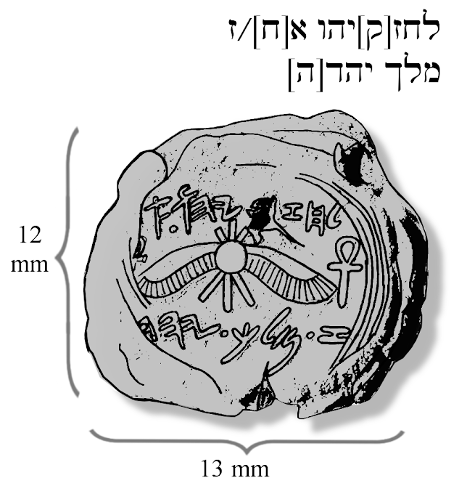
The Greek word typos originally referred to the impression made by a seal. In the ancient world, a signet pressed into clay authenticated a document and identified its sender. In a similar way, in Genesis, Adam is the stamped impression of Christ, while Christ himself is the true seal to whom that impression points. Adam was formed from the dust yet bore God’s image and reflected divine authority: “So God created man [ha-’adam] in his own image, in the image of God he created him; male and female he created them” (Gen 1:27). Because ha-’adam refers to Adam and Eve (male and female), they together were a “type” of Christ. Genesis 1 therefore typologically introduces the dominion of the coming Messiah who is the true Ruler (radah) and the ultimate archetype of ha-’adam.
Judah’s Scepter
What are we to make of the scepter in Balaam’s prophecy? A scepter represents royal authority, the ruler who wields it and sometimes the people under that authority. Balaam’s promise that a scepter would rise from Israel echoes Jacob’s blessing, also in Genesis: “The scepter shall not depart from Judah . . . until Shiloh comes; and to him shall be the obedience of the peoples” (49:10).
David, being from the tribe of Judah, partially fulfilled this promise when he became king over Judah and then Israel. But Jacob’s blessing, like Balaam’s prophecy, looks forward to the days to come. Its fullest expression was realized when Jesus was born as “the Son of David” (Matt. 1:1). Genesis thus again identifies the future ruler not only as Adam’s archetype but also as the King who arises from the tribe of Judah.
The Woman’s Offspring and Victor Over Evil
Balaam’s prophecy also foretells that Israel’s King will “crush” Moab and overcome Israel’s enemies. David’s victories offered a historical fulfillment of this, even as David credited ultimate victory to his Lord: “The Lord sends forth from Zion your mighty scepter” (Ps. 110:2). Jesus later confirms that David’s “Lord” is the Christ himself (Matt. 22:41–45).
David also links Balaam’s prophecy to God’s promise that the woman’s offspring will crush the serpent’s head in Genesis (3:15). David declares that the Messiah will “shatter heads” across the earth (Ps. 110:6). The Hebrew mahats rosh joins Balaam’s “crush” [mahats] with Genesis’s “head” [rosh], identifying David’s Lord with the serpent-crushing offspring. The Messiah is therefore the true Adam who fulfills humanity’s vocation, the King who bears Judah’s scepter, and the woman’s offspring who defeats evil.
The Reality to Which the Types Point
Genesis repeatedly gave Israel genuine signs of the promised Messiah. Adam, the scepter of Judah, and the woman’s offspring were “seal impressions” that anticipated Jesus Christ.
When the magi asked, “Where is he who has been born king of the Jews?” they sought the King to whom those impressions had long pointed. In Jesus’ birth, death, and resurrection, God confirmed his ancient promise. The true Ruler has come: the Son of David, the victor over evil, and the Savior established in our midst.
 Dr. Seong Hyun Park is provost and assistant professor of Old Testament. This reflection is adapted from his book (in Korean) Reading Genesis Anew (Seoul: Duranno, 2023). He recently co-authored “Humility Among Seminarian Women: A Qualitative Study,” Archive for the Psychology of Religion 48.1 (2026): 3-22. Source of image: Benjamin Stanhope, “First Temple Hebrew Seals and Bullae Identifying Biblical Persons: A Study of their Iconographic and Historical Significance,” MA Thesis, Hamburg University, 2019. Used with permission.