Ex Fonte Excerpt: Is There Room in our Minds for Other Worlds? – A conversation with Christian philosopher, scientist, and astrobiologist Andrew Davison
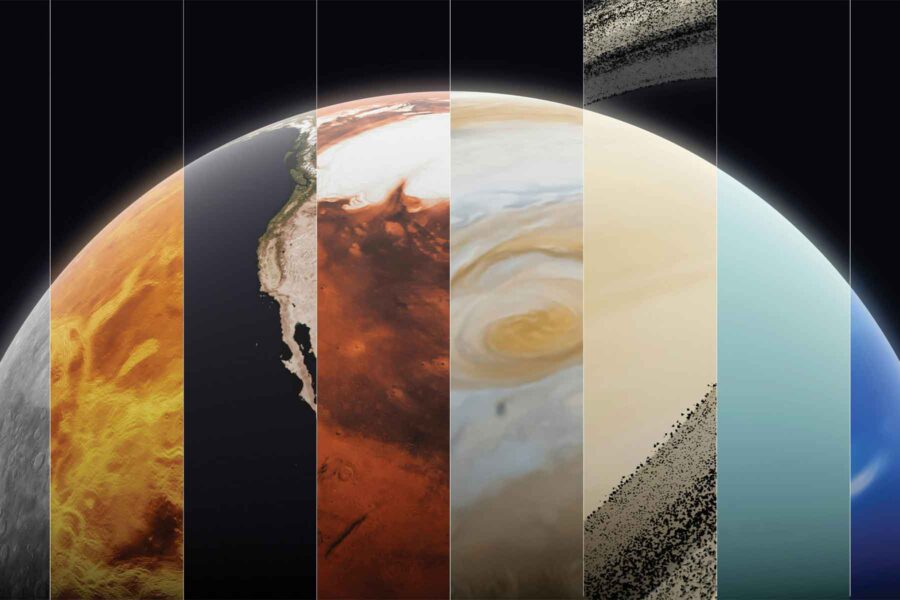
Andrew Davison’s work in astrobiology explores how classic Christian doctrine meets the question that no longer applies only to science fiction: Is there life beyond Earth? Ex Fonte’s editor in chief, Wendy Murray, probes with Davison how Scripture, Christian thinkers, and early modern science can inform and enlarge the Christian imagination today—without compromising either theological clarity or intellectual humility.
Your book focuses on “astrobiology” (extraterrestrial life), yet one portion includes the larger discussion of the existence of angels. Do you see a relationship between these entities?
It would be useful to make clear that I’m not saying that I think that what we mean by angels is extraterrestrial life on some other planet. I wanted to respond to the misconception that Christian theology is incapable of thinking about life beyond Earth because it’s always been “about us.” My first response, of course, is that Christianity is all about God.
Yet there’s plenty of space in the Christian imagination for other types of rational creatures outside of human categories, of which the angels is a great example. The angels help us cope with the question of whether it is “all about us.” The Book of Job also is useful there. Job has to learn that there’s a great deal more out there, and that he’s only a small part of it.
What is the layperson’s definition of astrobiology and its implications?
Astrobiology is the study of life in the universe and the capacity of the universe to harbor and bring forth and sustain life. I was part of a group of scholars who had the opportunity to spend almost a year researching and thinking about the implications for theology of life beyond Earth. The result was this book.
You make the distinction between the account in Genesis 1, where the sun and moon are simply called “lights, greater and lesser,” and the nature of the heavens as Job pictured it: “the morning stars sang together and all the heavenly beings shouted for joy.” Can you clarify the distinction?
Genesis demythologizes creation, because everything is God’s creature. The sun, moon, and stars are just lights; they have a job to do. Scripture is about understanding God, ourselves, sin, salvation, and how to live.
Calvin says astronomy is wonderful, but if you want astronomy, go to the astronomers. The Scriptures are about something more important than that: they’re about God, and who we are in relation to God. Psalm 8—“What is man when I consider the works of your fingers?”—puts humanity and our smallness in its place.
Do you see an unfallen world as a theologically viable possibility (such as C.S. Lewis depicts in his Space Trilogy and the planet of Perelanda)? And if so, what are the implications for the work of Christ?
There are about half a dozen or more chapters on Christology and Soteriology in the book. The Fall could be unusual, an anomaly; we might be one wart or rotten toenail on the whole otherwise sound body of God’s creation.
Even if there is never evidence, it will do our theology good to have looked at old questions from new angles. What does the Incarnation mean for a culture, a planet, a race that didn’t fall? Is Christ only a remedy for sin? Does the work of Christ stop at being remedial, or does it offer all of that and more?
Does it make us children of God, adopted alongside Christ? Does it make us “participants in the divine nature”? It seems to me that the work of Christ and the Incarnation lifts human beings to a dignity that outstrips even what they lost. In that sense, the work of the Incarnation has bearing even for an unfallen race.
So does this suggest that “the Fall” for other worlds is not an inevitability?
There is a fragility in being material. Yet sin is always a choice. As a theologian, I want to say sin is an aberration, and therefore it can’t be inevitable.
Has evidence of extraterrestrial life been found, and what does it look like?
We can divide that question into chemical signatures, astronomical bodies, and signals. We are starting to work out the composition of gases in the atmospheres of planets around other stars. Some compounds on Earth are only produced by life, and their presence elsewhere is tantalizing.
There may be something like 16 billion Earth-like planets around Sun-like stars. It would have to be unbelievably rare for there not to be other life out there.
I see God in the creation of a universe in which the capacity for life is woven into the laws of physics. God has made a living cosmos with the capacity to bring forth life.
Professor Andrew Davison, Regius Professor of Divinity at Oxford University, is a theologian whose work integrates Christian doctrine, philosophy, and the natural sciences, with particular attention to astrobiology and the possibility of life beyond Earth. Trained in chemistry, biochemistry, and theology at Oxford and Cambridge, he has held senior academic posts in theology and science at the University of Cambridge and is a founding member of the Leverhulme Centre for Life in the Universe. He is the author of Astrobiology and Christian Doctrine (2023), and in 2024 he was appointed Regius Professor of Divinity at Oxford.
 A longer version of this article appears in the current issue of Ex Fonte magazine. Purchase the individual issue.