Mentors

In my office are a picture of my wife, four kids, and 12 grandchildren, and, elsewhere, three additional photos of three men and a lady. Two men share a double frame, and a couple fills the third frame. These are my mentors (left to right): Kenneth Scott Latourette, John A. MacKay, and Eileen and Sam Moffett.
Every day when I come into my office, I am first centered by a picture of Jesus on the cross (done in Balinese batik, a textile art), followed by my family and my mentors. These are my select cloud of witnesses.
Who I am today has been very much shaped by those who have been my mentors, by those who have gone before me. Though I have been sanctified in another way by my calling as a husband, father, father-in-law, and “Grandpa,” here I would like to reflect on mentors.
Though my mentoring by my PhD supervisor at Princeton, Dr. Samuel Hugh Moffett, lasted only a matter of four years of my life, I find most every day that I am very much a “Moffett Disciple.” I don’t know how many “Moffett Disciples” there are, but the long shadows of Sam and his father, Samuel A. Moffett, have left me with a particular approach to scholarship, a way of viewing the ecumenical church, and a way of thinking about being a Christian leader. Sam and his wife Eileen did not have children, but I was like an adopted one!
When taking independent seminars or when preparing for my comprehensive exams, Sam and I would meet not in his office but in his home. Often with a child or two in tow, as I entered through the front door, his wife Eileen would escort the kids to the kitchen for a snack while I took off my shoes, put on Korean slippers, and shuffled into the dining room-cum-office to go over a paper with Sam. This mentoring bond always included not simply Sam, but Sam and Eileen. Eileen was a scholar in her own right, researching, keeping up with the development of Presbyterian churches in Korea and promoting mission!
Sam, who was raised in Korea by a pioneer missionary and a mother who was a classics scholar, spent his summers there learning Greek and Latin from his mother. He was always warm-hearted with a wry, ironic sense of humor, but underneath was a mind as sharp as a razor. He knew his languages (although he preferred to preach in English when in Korea!) and asked penetrating questions when the history division would meet at Princeton. I became a much more meticulous and exacting scholar under his tutelage. When his career choice was made, he chose to be a missionary, not to Korea (to him, that was home) but to China.
Moffett was educated at Yale by one of the greatest Christian historians of the twentieth century, Kenneth Scott Latourette, another whom I deem an indirect mentor. Latourette was a disciple of the Student Volunteer Movement and initially went to be a missionary in China. Amoebic dysentery redirected his call, and he ended up instead in the field of scholarship on behalf of the Church, especially the church in Asia. “Uncle Ken,” as he was known at Yale, lived in a dorm suite on campus at Yale, and opened his domicile to students for prayer, Bible Study and discussion. He was both a prolific and precise historian. His great tomes include his monumental seven-volume History of the Expansion of Christianity, his five-volume History of Christianity in a Revolutionary Age, and standard histories of Japan, China, East Asia, missions in China and even the development of democracy. He published a volume about every 18 months.
KSL also seemed to have had a photographic memory. When Stephen Neill sent KSL his draft of the History of Christian Missions, Latourette read it and sent back a note that it was “. . . very good, and I only found 5 factual errors.”
In a frame alongside Latourette is a picture of a Scottish missionary to Latin America who later became one of the founders of the World Council of Churches and the President of Princeton Theological Seminary, Dr. John A. MacKay.
MacKay was committed to missionary work among Latin-American intellectuals and was committed to church unity in mission. Under his leadership at Princeton, he preached every Monday morning at the seminary chapel, providing theological leadership for the seminary. He also developed a required course on mission and unity with an accompanying textbook, which he wrote, titled Ecumenics: The Science of the Church Universal. The approach to Christian unity in and for mission guided his leadership and scholarship. In fact, my PhD program, in MacKay-like fashion, focused on MEHR: Mission, Ecumenics and History of Religions. To this day, I think in terms of these categories when writing and speaking about the missio Dei.
So, I enter my office each day, flip the light switch, hang up my coat and look over at my mentors—one Baptist and three Presbyterians. One was a missionary to Latin America, one to Lebanon and Korea, one to China, and one to China then Korea. All lived as scholars in service to God’s missional church in Christian unity. Their words, work, and attitudes continue to guide me most every day. And I am so very grateful, so very grateful.
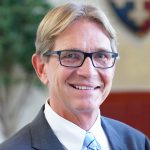 Dr. Scott W. Sunquist, president of Gordon-Conwell Theological Seminary, is author of the “Attentiveness” blog. He welcomes comments, responses, and good ideas.