Ex Fonte Excerpt: That Hideous Strength: A revelation for our time – Caught in a Cosmic War

Jonathan Zoba
That Hideous Strength, the third book of the Space Trilogy (preceded by Out of the Silent Planet and Perelandra), is C.S. Lewis’s magnum opus. By this I mean that the message in all of his other books is contained in this singular novel. He said on many occasions that fairytales can be used to deliver more truth than non-fiction. In my opinion, this volume expresses the truest revelation of the mind and soul of Lewis. Most of his non-fiction is framed within the arguments and constraints of the academic setting of his time. His Narnia series is set within the constraints of children’s literature (not to imply that it is not also for adults). But in the Space Trilogy, all creative constraints have been removed, and we get the most vivid and thorough revelation, not only of Lewis’ genius and creative imagination, but of the cosmic war that is occurring on our planet. Through the circumstances of the characters in the story, Lewis makes arguments about materialism and religion that would take volumes of non-fiction to make.
The Two Sides of the War
When the story begins, Mark Studdock, a sociologist, had been a member of the Progressive Element, a clique of intellectuals hard at work to overthrow the “old-fashioned” ways of Bracton College. Always minded to climb the social ladder, he receives an invitation to join its parent organization, the N.I.C.E. (National Institute for Co-ordinated Experiments), located at nearby Belbury, the organization’s operational headquarters. The N.I.C.E. seeks to implement the clique’s ideas on a national scale. As he rises in the ranks, he is confronted with the reality that “materialism” was simply a ruse to induce initiates into pure nihilism (what the N.I.C.E. calls “objectivity”). As he goes further into the inner circle it becomes clear that “objectivity” is not the endgame, but rather absolute subservience to a dark spiritual power (known in the book as macrobes).
In contrast to Belbury, Mark’s wife Jane has taken a different path. In response to disturbing prescient dreams, a friend directs Jane to the mysterious Manor at St. Annes. This community is built upon the spiritual principles of loyalty, obedience, and service, and is formed around allegiance to its Director, none other than Elwin Ransom (the protagonist of the first two novels in the trilogy). At first, possessing modern ideas about marriage and independence, Jane is reticent about being obedient to the “Director” (or to anyone at all). But over time, in the setting of a lovely mansion surrounded by gardens and greenhouses (and shared with many friendly animals), she learns the joy of obedience, humility, and the sanity of accepting her God-given womanhood. Jane’s journey is the opposite of Mark’s: the more she humbly submits to the kingdom of light, the freer and more herself she becomes.
Coercion vs Volition
With financial insecurity as a pretext, the Progressive Element cunningly pressured Bracton College into selling it’s sacred Wood to the N.I.C.E., ostensibly for scientific reasons, but (unknown to its materialist adherents) it was really for ancient and mythical reasons. When Mark joined the N.I.C.E. he was left in a fog as to what his role was supposed to be. Eventually he learned that individual roles are a farce. Unconditional submission to the Head is the Institute’s only rule. Through trickery and blackmail (and a little bit of financial insecurity) Mark was coerced into obedience to the N.I.C.E.. The subversive work they did to exploit Bracton College is the same thing they do to any individual who chances to become subject to their influence.
Conversely, at the Manor, the Director does not pressure Jane to avail her clairvoyant powers to him but only invites her to join them freely. St. Anne’s expresses the nature of the heavenly kingdom; indeed, it is a small unit of organization on earth that is, through Ransom, an extension the government of Deep Heaven. They await instructions from Ransom through his contact with the superhuman entities (eldila) who serve a loving God (called “Maleldil” in the trilogy). He is their “Pendragon”—taken from the Arthurian legend—as the rightful spiritual ruler of Britain in Lewis’s ancient mythology. Lewis believed every nation and culture has a God-given “soul”––an essential spirit that coheres its essence making it unique and real in a cosmic sense (in other words, something that makes England “English”). And this is likewise true on an individual level, as seen in Jane’s voluntary surrender, becoming more truly herself.
Voluntary obedience to the heavenly order enlivens this essential spirit, begetting uniqueness, originality, and freedom. The power of Belbury seeks to snuff out this spirit in every people group through well-organized social engineering. Often coming under popular appellations, this program doesn’t actually intend to deliver the promises it makes, but rather insidiously to enslave all who embrace its “progressive” teachings.
Hubris vs. Humility
At St. Anne’s, the self is not the center. They abide by a clear hierarchy of leadership, from Deep Heaven down to the inhabited worlds under the chain of authority depicted as Maleldil (God) to the eldila, to Ransom, to the little community at St. Anne’s. There is always a Pendragon steering his people toward the pattern of heaven. Because the hierarchy is fixed in the heavens and accepted on earth, there is peace at St. Anne’s. All the parts are arranged according to the cosmic order.
But the institute at Belbury is a derangement of the cosmic order. At its core (and the seed of its own destruction) is hubris—pride, the sin of Lucifer—which animates the whole enterprise. With promises of joining the technocratic elite, the best and brightest are lured into its ranks. The spirit of the Tower of Babel––“that Hideous Strength”––continually asserts itself in new form throughout the ages. Lewis’s point is, when an angel or a man rejects the cosmic order, he must attempt to place himself at the center of the cosmos, and he does this by lifting himself higher and higher, until Deep Heaven comes crashing down on his head.
Fiction Reveals Fact
I am inclined to believe that Lewis used this fairytale to reveal cosmic events that were actually occurring in the twentieth century when he wrote it. The eldila came down to challenge the evil macrobes in their global conspiracy to enslave the human race. Though, in the book, the conspirators were stopped at Belbury, in real life, Lewis would say, they have many more cards to play.
How would Lewis advise us to respond to this world-wide conspiracy seeking to enslave and subdue the planet? He would urge us to remember that the powers of Deep Heaven, too, are on the move. In the end, Maleldil, the true King—will prevail. Until then, we do our daily duties with faithfulness and obedience. We serve our husband or wife, we raise our kids, we meet together and discuss books. The cosmic war goes on around us. But for now we must wait, be faithful, and grow vegetables.
Jonathan Zoba, a graduate of Gordon College, is a teacher and farmer who oversees horticultural and educational programming at The Garden School in Beverly, MA. He helps lead the C.S. Lewis Society of Beverly.
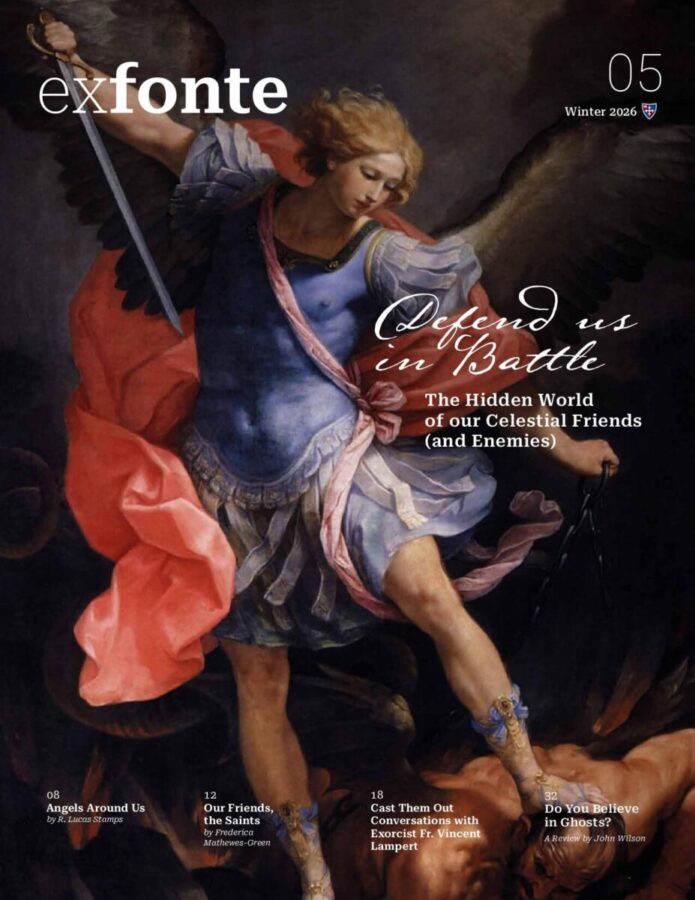 A longer version of this article appears in the current issue of Ex Fonte magazine. Purchase the individual issue or subscribe.