6 Courses (18 Credits)
Available 100% online or residentially at our Charlotte campus.
6 Courses (18 Credits)
Available 100% online or at our Charlotte campus.
The Graduate Certificate in Lutheran Studies equips students for Word and Sacrament ministry in the Lutheran tradition.
Rooted in the rich theological heritage of the Lutheran tradition and shaped by Gordon-Conwell’s ecumenical commitment to faithful biblical scholarship, the Graduate Certificate in Lutheran Studies is designed for those preparing for Word and Sacrament ministry, as well as for clergy and laity seeking ongoing theological education. This pan-Lutheran program equips students for spiritual and confessional renewal across diverse church bodies. This certificate includes six foundational courses in theology, and ministry. With a modular design, the Certificate in Lutheran Studies is stackable and build towards any master’s degree.
This certificate program is ideal for:
- Elders and Deacons
- Church Staff
- Small Group Leaders
- Christian Mentors
- Campus Ministry Staff
- Missionaries
Courses
Six courses (18 credits)

Christian Ethics (in the Lutheran Tradition)
This course will focus on the moral theology of the Lutheran tradition and emphasize the Christian as moral agent. The intention is to provide a scriptural and theological framework for making disciples who will actively examine their lives in Christ (2 Cor. 13:5), hold fast to the commandments of their Lord (John 14:15), and show the world a more excellent way (1 Cor. 12:31).
Lutheran Confessions
An in-depth reading and reflection upon the Lutheran Confessions, contained in The Book of Concord: The Confessions of the Evangelical Lutheran Church, in their historical context and as contemporary witnesses of the church’s faith.
General Elective
Any three credit hour course.
Lutheranism in North America
A survey of the theological movement of Lutheranism as it took shape in the North American context. Primary focus will be on major Lutheran personalities, organizational alliances and mergers, theological formulations, doctrinal controversies, liturgies and spiritualties.
Martin Luther and the Reformation
An introduction to the life, theology, ministry, and spirituality of Martin Luther. After a study of Luther’s life and ministry, primary focus will be upon the thematic reading, discussion, reflection, and evaluation of selected writings of Luther. Students are encouraged to develop, not only an historical appreciation for Luther’s theology, but to consider the ways in which his thought is of enduring import for faithful ministry in the church today.
Lutheran Liturgics and Homiletics
For many years in Lutheran circles, the chief goal, the main tasks, indeed the purpose, of the ordained ministry has been described as “to preach, teach, and administer sacraments.” Two (and sometimes, all three) of those happen in the midst of worship (liturgy). The ordained minister, a pastor, needs to know the history, theology, and “mechanics of doing” liturgy in order to properly to serve Christ’s Church and His people. Knowledge of how Church leaders of the past (especially Lutheran ones) have understood and performed their role is essential for those endeavoring to perform the tasks and role of the gospel now in the arena in which the people of the gospel gather, i.e., liturgy. Furthermore, even before early Christian writers of the second century (e.g., Ignatius of Antioch, +115, and Justin Martyr, + 165) write about the importance of liturgy, there is witness to liturgy and corporate prayer in the Scriptures. In order to carry out their vocation, pastors require knowledge of the history, meaning (theology), and mechanics of worship (practical aspects of worship actions and leadership), and how liturgy and preaching function together in gospel proclamation. To investigate these areas is the rationale and purpose of this course.
Further Study
Our Graduate Certificates are intentionally modular, allowing you to stack certificates together to build towards (or even complete) a master’s degree.
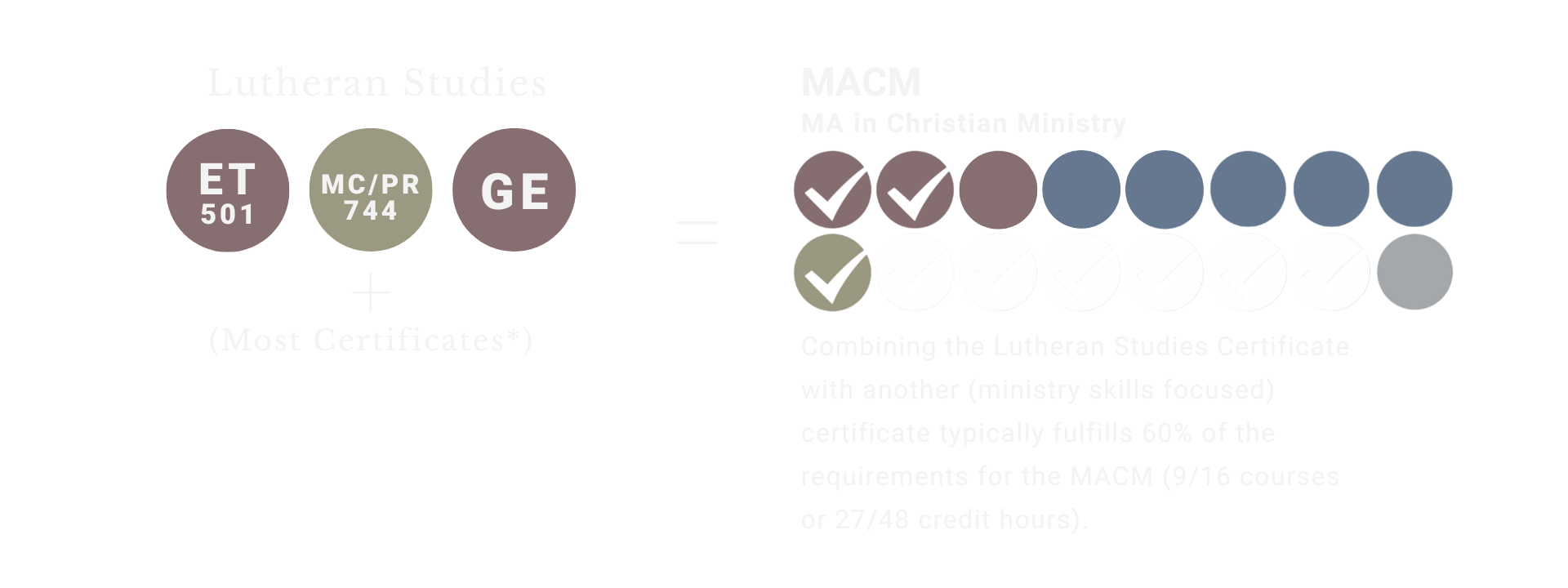
*The MACM is a “professional degree,” which primarily means it is weighted toward developing practical ministry skills. As such, six of the concentration electives in the MACM should be drawn from practical theology or counseling courses. Currently, the Certificate in Spiritual Formation fits ideally in this scenario.
In the same way, certificates can be applied toward the MATS (60 credits) or the MDiv (90 credits). Graduate certificates allow you to start small and work toward a full MA.
Faculty Advisor

Have Questions?
Someone from our friendly admissions team would be happy to reach out to you.