Ex Fonte Excerpt: Just Look Up—and Beyond
Sean McDonough
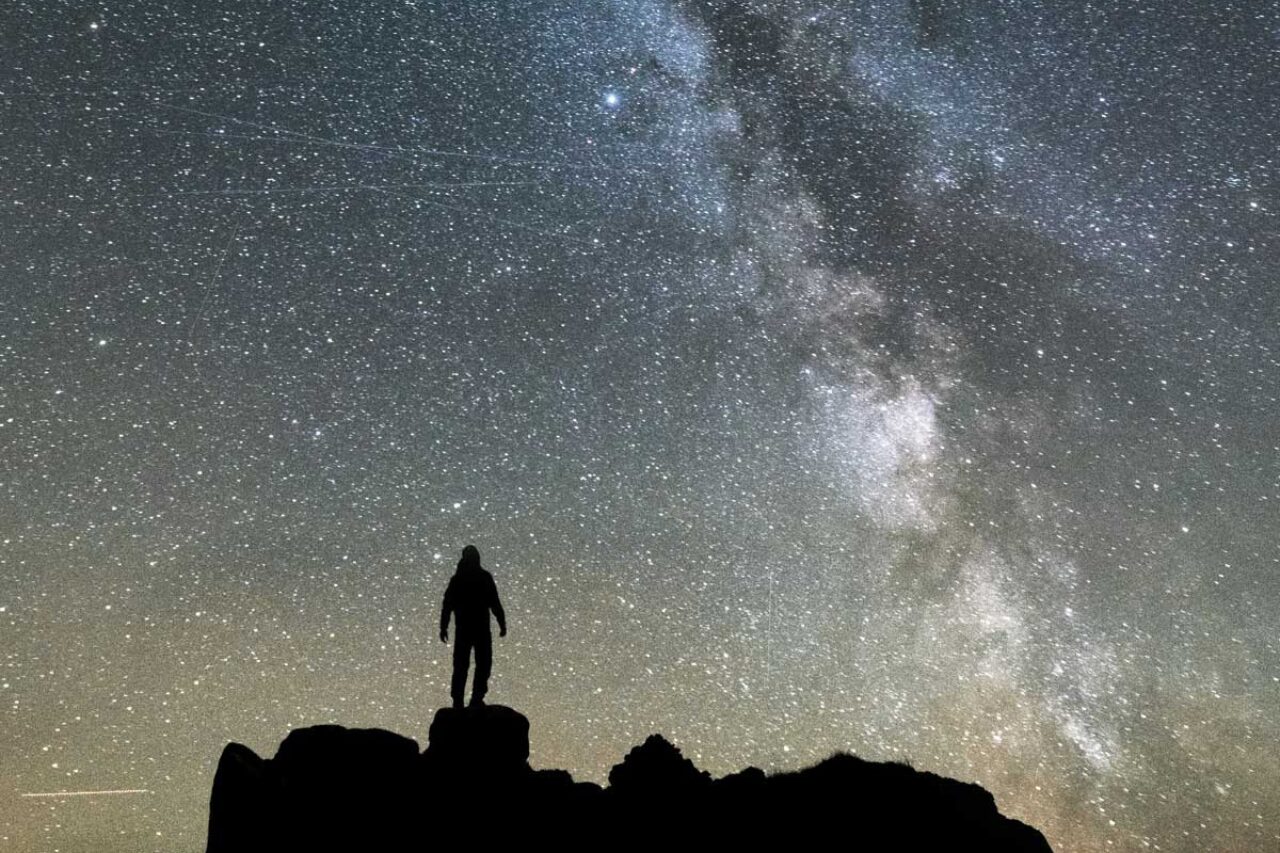
It is remarkable what you can see if you just look up.
From my humble patch of earth here on the North Shore of Boston, I can see the stars ablaze in the northeast night sky, with the belt of Orion hanging on the horizon, recognizable even to the most amateur astronomer. I recall in 1997 walking out my back door in St. Andrews, Scotland, each night to watch the slow-moving Hale Bopp comet make its way serenely across the sky—it bored through the ether at a mere 98,000 miles per hour, so the spectacle lasted for days. Farther back, and farther afield (literally), I lay on a New Hampshire hillside and was struck by the Perseid showers (not literally), enraptured by the sight of countless meteors burning only sixty miles or so above me.
The problem, is, however, that we don’t often look up nowadays. The reasons we keep our eyes earthbound are generally banal and slide effortlessly into metaphors for spiritual lassitude. The northeast night sky where I live is bright, but if I turn in other directions the stars are snuffed out by the lights of streetlights and shopping malls.
Or we fail to see the celestial stars because we are staring down at our phones, stuck on Instagram seeing what the earthly “stars” had for dinner. The comfort of staying safe in our cozy homes outshines the prospect of seeing the northern lights, which would require us to stay up a bit later and walk two hundred yards where the light pollution is a little less. Enchanted by our technology, sheltering in place in our safe spaces, we can’t be bothered even to look ad astra.
It was not always so. Modern people tend to look at the past as an endless series of Dark Ages—but at least the “darkness” allowed them to gaze up at the heavenly lights. For the ancients, the stars were alive; they were speaking for those who had ears to hear. It is no coincidence that our astronomical terms go back to the names marking the gods of antiquity, and that they witness to a world where earth and heaven were seen as mutually embracing realities.
The stars told the story of Orion, the great hunter slain (Intentionally? Accidentally?) by the goddess Artemis. The Perseids are so called because they alight in the constellation Perseus—the son of heavenly Zeus and earthly Danaë, who slew Medusa and rescued Andromeda. Comets struck the Greeks as looking like long human hair (komē), and so the flaming stones above bear the name of the humble strands on earthly heads. Stars came to earth, humans went to the heavens, and stories were told about them all.
Of course, the enchantment of imagining the stars were gods and heroes had, like the moon, its dark side. If the heavenly bodies were that powerful, they must control life on Earth, and so one was tempted to a grim fatalism: the stars were not only telling stories; they were also writing an irrevocable destiny for the world. You might gain some power over other humans by your astrological insights, but there was no stopping what was coming . . .
Dr. Sean McDonough is the Mary French Rockefeller Distinguished Professor of New Testament at Gordon-Conwell. He is author of many books including, The Preacher’s Greek Companion to Philippians: A Selective Commentary for Meditation and Sermon Preparation (Hendrickson, 2023) and “Revelation” (co-written with G.K. Beale) in Commentary on the New Testament use of the Old Testament, edited by G.K. Beale and D.A. Carson, (Baker Academic, 2007).
 A longer version of this article appears in the current issue of Ex Fonte magazine. Purchase the individual issue.